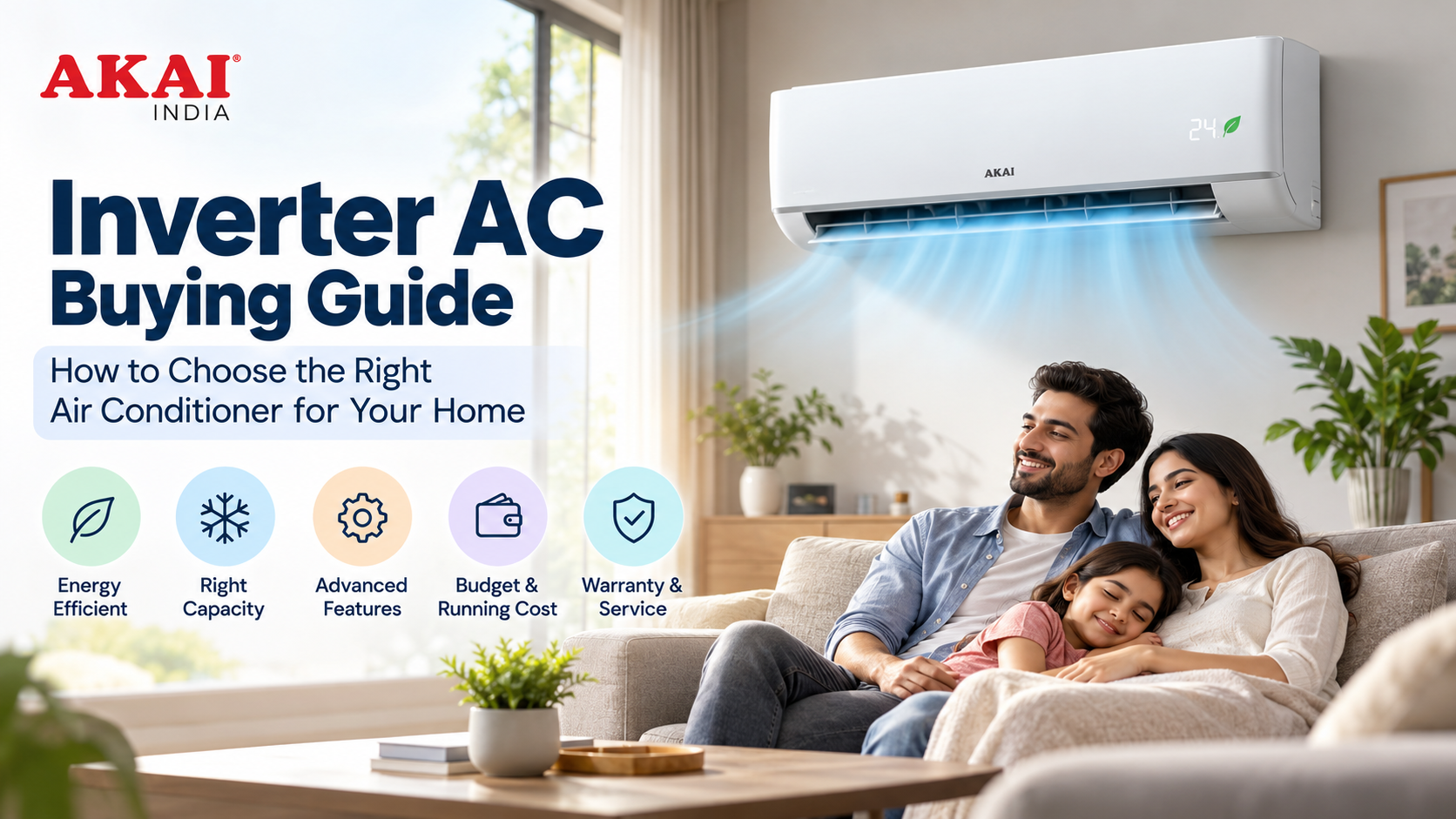
Choosing the right air conditioner involves more than comparing prices or selecting a model with the highest star rating. You need to consider your room size, cooling requirements, electricity consumption, local climate, installation conditions and long-term maintenance costs. An inverter AC can be a practical choice for households that want consistent cooling and better control over energy use, particularly during India's hot summer months.
However, not every inverter air conditioner is suitable for every room. A model designed for a small bedroom may struggle to cool a large living room, while an unnecessarily powerful unit may increase your initial purchase cost. Understanding the features that matter can help you make a more informed decision.
This inverter AC buying guide explains how inverter technology works, how to select the right capacity, which features deserve attention and what to check before purchasing an air conditioner for your home. Whether you are buying your first AC or replacing an older unit, these practical considerations will help you choose a model that suits your comfort and budget.
What Is an Inverter AC?
An inverter AC is an air conditioner that uses variable-speed compressor technology to regulate its cooling output according to the room's requirements.
Unlike a conventional fixed-speed compressor that generally switches between running at full capacity and switching off, an inverter compressor can adjust its speed as the cooling demand changes. When the room approaches the set temperature, the compressor can reduce its output rather than repeatedly operating at full power.
This technology helps maintain a more consistent indoor temperature and can reduce electricity consumption under suitable operating conditions.
How Does an Inverter AC Work?
An inverter AC uses electronic controls to adjust compressor operation according to factors such as the room temperature, selected temperature setting and cooling demand.
For example, imagine switching on an inverter AC in a warm bedroom after returning home on a summer afternoon. The compressor may initially operate at a higher speed to cool the room. Once the desired temperature is approached, it can slow down and continue providing the cooling needed to maintain comfort.
Actual performance depends on the model, room conditions, insulation, outdoor temperature and usage habits.
Key Benefits of an Inverter AC
An inverter air conditioner can offer several practical advantages:
- Energy-efficient operation: Variable-speed compressor control can reduce unnecessary power consumption compared with some conventional fixed-speed systems.
- Consistent cooling: The compressor adjusts its output to help maintain the selected temperature.
- Reduced temperature fluctuations: Continuous modulation can make indoor conditions feel more stable.
- Potentially quieter operation: Lower compressor speeds may reduce operating noise, depending on the model and installation.
- Flexible everyday use: Inverter technology can be useful in bedrooms, living rooms and other spaces where an AC operates for extended periods.
Keep in mind that savings are not guaranteed to be the same for every household. The actual difference depends on the specific models being compared and how they are used.
1. Choose the Right Inverter AC Capacity for Your Room
Cooling capacity is one of the most important factors when buying an inverter AC. It determines how effectively the unit can remove heat from your room.
An air conditioner with insufficient capacity may run for long periods without providing adequate comfort. A unit with excessive capacity may cost more than necessary and may not be the most suitable choice for your room.
The correct capacity depends on several factors, including floor area, ceiling height, sunlight exposure, the number of occupants, heat-generating appliances and the local climate.
Which AC Capacity Should You Choose?
The following ranges are only starting points for typical residential rooms. They are not substitutes for a proper cooling-load assessment.
- 1-ton inverter AC: Often considered for smaller bedrooms or compact rooms with relatively low heat gain.
- 1.5-ton inverter AC: Commonly considered for medium-sized bedrooms and living spaces.
- 2-ton inverter AC: May suit larger rooms or spaces with higher cooling loads.
These tonnage figures refer to cooling capacity, not the physical weight of the appliance.
For example, a compact bedroom with limited sunlight may need less cooling than a similarly sized room on the top floor with large west-facing windows. The second room receives more heat and may require a higher-capacity unit.
When Should You Consider a Higher Capacity?
Consider professional capacity assessment if your room has:
- Large windows receiving direct sunlight.
- A high ceiling or an exposed roof.
- Several occupants for extended periods.
- Multiple computers, televisions or other heat-generating appliances.
- Open connections to adjoining rooms.
- Particularly high outdoor temperatures during summer.
Do not choose a larger inverter AC solely because you expect it to cool faster. Match the unit to the actual cooling requirement and check its rated capacity and operating range.
2. Check the Energy Efficiency Rating
Electricity consumption is an important consideration because an AC can account for a significant share of household power use during summer.
When comparing inverter AC models in India, check their current Bureau of Energy Efficiency (BEE) star labels and the applicable efficiency information. A higher star rating generally indicates better energy efficiency within the relevant rating category and testing framework.
However, star ratings should not be the only basis for your purchase decision.
How to Compare Energy Efficiency
Before purchasing, check:
- The BEE star rating displayed on the product.
- The applicable annual energy consumption figure, where provided.
- The rated cooling capacity.
- The model's cooling performance under the relevant test conditions.
- The period for which you expect to use the AC each year.
A model with a higher upfront price may offer better long-term value if its efficiency advantage produces meaningful electricity savings.
Estimate Your Electricity Costs
You can estimate running costs using this simple formula:
Electricity cost = Average power consumption in kW × Operating hours × Electricity tariff per unit
For example, if an AC averages 0.8 kW of electrical input during a particular period, runs for 8 hours per day and your electricity tariff is ₹8 per unit, the estimated daily cost would be:
0.8 × 8 × ₹8 = ₹51.20 per day.
This is an illustrative calculation, not a prediction of the consumption of any specific inverter AC. Actual input power varies with compressor speed, outdoor temperature, room conditions and operating settings. Fixed charges and other bill components are also excluded.
For a more accurate estimate, refer to the model's energy label and monitor actual consumption after installation.
3. Understand the Cooling Features That Matter
Modern air conditioners can include several features intended to improve comfort, convenience and performance. Instead of paying extra for every available feature, prioritise those that match your household's requirements.
Adjustable Compressor Operation
Variable-speed compressor control is the defining feature of an inverter AC. Check the product specifications for its rated capacity and operating range rather than assuming every inverter model performs identically.
High-Ambient Cooling Performance
Indian summers can bring very high outdoor temperatures, especially in inland regions. If your area experiences extreme heat, check the manufacturer's specified operating temperature range and cooling performance at high ambient temperatures.
A feature advertised as suitable for extreme heat should be supported by the model's technical specifications.
Air Filters
Air filters help capture dust and other particles from the circulating air. Check the filter type, cleaning instructions and replacement requirements.
If your home is near a busy road or experiences frequent dust, accessible filters and straightforward maintenance can be particularly useful.
Remember that standard AC filters are not a replacement for dedicated air-purification equipment when specialised filtration is required.
Sleep and Timer Modes
Sleep modes can adjust operation during the night, while timers help schedule when the AC starts or stops. These functions may improve convenience and help prevent unnecessary operating hours.
Check how each mode works on the specific model rather than assuming all ACs use identical settings.
Noise Levels
Noise matters when installing an AC in a bedroom, nursery or home office. Check the published indoor noise level, especially if you are sensitive to sound while sleeping or working.
Proper installation, secure mounting and suitable placement also affect perceived noise.
4. Decide Between a Split AC and a Window AC
Many buyers compare inverter technology with split and window AC designs. These are different considerations: inverter describes compressor control, whereas split and window describe the unit's physical configuration.
Split Inverter AC
A split inverter AC has an indoor unit and an outdoor unit connected through refrigerant piping.
It may be suitable if you want a wall-mounted indoor unit, flexible placement and a relatively unobtrusive appearance. However, installation requires suitable space for the outdoor unit, pipe routing and drainage.
Window AC
A window AC combines its main components in a single unit and is generally installed in a suitable window or wall opening.
It can be worth considering where installation space and the existing structure favour a single-unit design. Availability of inverter technology varies by product range, so verify the actual specifications before purchasing.
Which Is Better for Your Home?
Choose based on the available installation space, cooling requirement, noise considerations, budget and the products available in your preferred capacity. Do not assume that every split AC is an inverter AC or that every window AC uses conventional compressor technology.
5. Check the Copper Coil and Heat Exchanger Specifications
The heat exchangers in an air conditioner transfer heat between indoor and outdoor air. Buyers often compare copper and aluminium components when evaluating durability and maintenance considerations.
Copper is widely used in refrigerant tubing because of its heat-transfer properties and suitability for common refrigeration applications. However, the overall reliability of an AC depends on more than the material alone.
When evaluating a model, check:
- The stated condenser and evaporator specifications.
- Corrosion-protection features, if provided.
- The manufacturer's maintenance recommendations.
- Warranty coverage for relevant components.
- The availability of authorised service and replacement parts.
Do not assume that a particular coil material automatically guarantees better cooling, lower electricity bills or a longer service life. Installation quality, operating conditions and maintenance also matter.
6. Evaluate the Price Beyond the Initial Purchase
The purchase price is only one part of the total cost of owning an inverter AC. A more affordable model may be attractive initially, but the final cost can change depending on installation requirements, accessories, servicing and electricity use.
What Should Your Budget Include?
Consider these expenses before placing an order:
- The air conditioner's purchase price.
- Standard installation charges.
- Additional copper piping, insulation or drainage work, if required.
- Electrical wiring, a suitable circuit and other electrical work.
- A mounting stand or other accessories, where applicable.
- Future cleaning and routine maintenance.
- Potential repair costs outside the warranty.
Ask the seller for a clear breakdown of included and excluded services. Confirm whether the quoted price includes installation, delivery, standard piping and any required mounting accessories.
How Do You Decide Whether a More Expensive Model Is Worth It?
Compare models with similar cooling capacities and consider the features you will actually use. An efficiency improvement may be valuable if you run the AC for many hours each day, while advanced connectivity may have less value if you do not need remote control.
For example, a household using an AC throughout the night may benefit more from efficient operation and low indoor noise than from features designed primarily for occasional convenience.
The best purchase is the one that balances the initial budget with expected operating costs, comfort and after-sales support.
7. Check the Warranty and After-Sales Service
An air conditioner is a long-term household appliance, so service availability should be part of your buying decision.
Before choosing an inverter AC, review the warranty terms and the conditions under which service is provided.
Check the following:
- The warranty period for the complete product.
- Separate warranty coverage for the compressor, if offered.
- Whether labour and refrigerant-related costs are covered.
- Any registration or installation conditions.
- The availability of authorised service in your area.
- The process for raising a repair request.
A longer compressor warranty does not necessarily mean every repair expense will be covered. Read the terms carefully and retain your invoice and installation documentation.
When considering an AC from Akaiindia, review the specific model's published specifications, warranty details, installation terms and available customer support before making a final decision.
8. Consider Your Room Layout and Installation Requirements
Even a suitable inverter AC may perform poorly if it is installed in the wrong location.
Ideally, the indoor unit should allow cool air to circulate throughout the room without being obstructed by tall furniture or curtains. Avoid placing the unit where its airflow directly causes discomfort during sleeping or working.
The outdoor unit also needs suitable ventilation and an installation position that allows safe servicing. Poor ventilation around the outdoor unit can affect performance, particularly during hot weather.
Before installation, confirm:
- Whether the wall can support the indoor unit.
- Whether the outdoor unit has adequate airflow and service access.
- Whether the refrigerant piping route is appropriate.
- Whether condensate drainage can be arranged correctly.
- Whether the electrical supply and protective devices meet the manufacturer's requirements.
Use a qualified installer and follow the manufacturer's installation guidelines. Improper installation can affect cooling performance, reliability and warranty coverage.
9. Common Mistakes to Avoid When Buying an Inverter AC
Avoid these common purchasing mistakes to get better value from your investment.
Choosing Capacity Based Only on Room Size
Floor area matters, but sunlight, ceiling height, occupancy and local weather can change the required cooling capacity. Assess the complete room rather than relying on a basic tonnage rule.
Assuming a Higher Star Rating Always Means the Best Purchase
Compare the efficiency label, capacity, purchase price and expected operating hours together. A higher-rated model may be worth the additional cost, but the benefit depends on your usage.
Ignoring Installation Charges
An attractive online price may not include all installation work. Confirm the complete cost before ordering.
Buying Features You Will Never Use
Wi-Fi connectivity, specialised modes and other extras may be useful for some households but unnecessary for others. Prioritise cooling performance, energy efficiency, service availability and features relevant to your routine.
Overlooking Maintenance
Dirty filters, obstructed airflow and neglected outdoor units can affect performance. Choose a model with accessible filters and follow its recommended service schedule.
Ignoring Local Service Availability
Before purchasing, confirm that authorised service is available where you live and understand how to request assistance.
10. Is an Inverter AC the Right Choice for Your Home?
An inverter AC is worth considering if you regularly use air conditioning and want variable compressor operation, more consistent temperature control and the potential for improved energy efficiency.
It can be particularly suitable for bedrooms, family living spaces and home offices where cooling is needed for extended periods. Households that use an AC only occasionally should also compare the purchase price, expected usage and available alternatives before deciding.
The right choice ultimately depends on your room, climate, electricity tariff, usage habits and budget.
For example, a small bedroom used mainly at night may need a different capacity and feature set from a large living room that receives direct afternoon sunlight. Likewise, someone who runs an AC for several hours daily may place greater importance on energy efficiency than a person who uses it for short periods.
The goal is to select a model that provides adequate cooling without paying for unnecessary capacity or features.
Frequently Asked Questions About Inverter ACs
1. Is an inverter AC better than a normal AC?
An inverter AC can provide more consistent temperature control and may consume less electricity than a comparable fixed-speed AC under suitable operating conditions. The actual advantage depends on the models, room conditions, usage patterns and maintenance.
2. Which inverter AC capacity is suitable for a bedroom?
A 1-ton or 1.5-ton inverter AC may be suitable for many bedrooms, depending on room size and heat gain. Larger rooms or spaces exposed to strong sunlight may need a different capacity. A cooling-load assessment is the most reliable way to decide.
3. Does an inverter AC reduce electricity bills?
It can reduce electricity consumption compared with some conventional ACs, particularly when cooling demand varies over extended operating periods. Savings depend on efficiency, outdoor temperature, thermostat settings, insulation and daily usage.
4. What temperature should I set on an inverter AC?
A setting around 24°C is a reasonable starting point for comfortable indoor cooling in many homes. Adjust it to your comfort, humidity and room conditions. A moderate setting may help control consumption compared with unnecessarily low temperatures.
5. How many hours can an inverter AC run continuously?
An inverter AC can generally operate for extended periods when correctly installed and maintained, provided it is used within the manufacturer's operating limits. Follow the user manual and arrange servicing as recommended.
6. Is a 5-star inverter AC worth buying?
A 5-star inverter AC may be worthwhile if you use it frequently and its efficiency advantage offsets the additional purchase cost over time. Compare the applicable energy labels, prices and your expected usage before deciding.
7. What should I check before buying an inverter AC online?
Check cooling capacity, BEE star rating, energy consumption, product dimensions, cooling features, warranty, installation charges, delivery terms and local service availability. Review the exact model specifications rather than relying only on promotional descriptions.
8. How often should an inverter AC be serviced?
Follow the manufacturer's recommended maintenance schedule. Clean accessible filters as instructed and arrange professional inspection when recommended or when you notice reduced cooling, unusual noise, drainage problems or other performance issues.
Conclusion
Buying the right inverter AC requires balancing cooling capacity, energy efficiency, comfort features, installation requirements and long-term ownership costs. Start by assessing your room and climate, then compare suitable models using their official specifications and energy labels. Check warranty coverage, installation charges and local service availability before making your final choice.
For homeowners comparing air conditioners, Akaiindia is a brand worth considering as part of the selection process. Review its available inverter AC models, compare their cooling capacities and features, and choose the option that fits your space and budget. A well-matched air conditioner, installed correctly and maintained regularly, can help you enjoy comfortable indoor temperatures throughout the summer while making more informed decisions about electricity consumption.