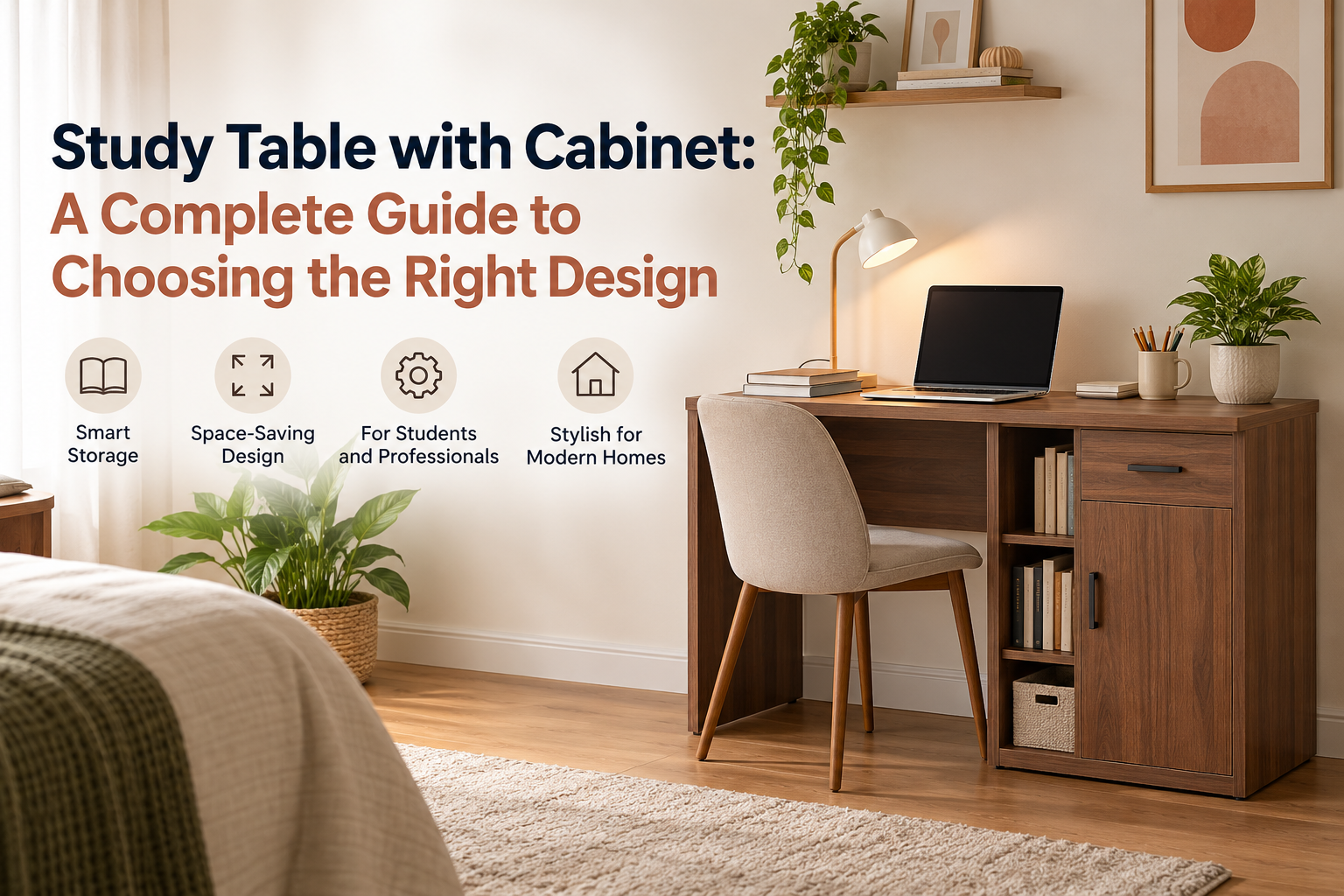
Choosing the right study table with cabinet is about more than selecting a table that looks good. A well-designed study table should give you enough working space for books, notebooks, a laptop or computer while also providing practical storage for stationery, documents and other essentials.
A cabinet makes a study table more functional because it helps keep frequently used items organised without requiring a separate storage unit. This can be especially useful in bedrooms, student rooms, home offices and compact apartments where floor space is limited.
Whether you are buying a study table for a child, teenager, college student or working professional, the right design depends on the available space, storage requirements, table size, material, construction and daily usage.
This guide explains the key factors to consider when choosing a study table with cabinet, along with practical buying tips to help you make a suitable decision.
What Is a Study Table with Cabinet?
A study table with cabinet combines a work surface with built-in enclosed storage. Depending on the design, the cabinet may be positioned beside, above or underneath the tabletop.
The storage area can be used for:
- Books and textbooks
- Notebooks and files
- Stationery
- Chargers and electronic accessories
- Documents
- Craft and study supplies
- Personal items
Unlike a simple study table, a cabinet-based design gives you dedicated storage without taking up the additional floor space required for a separate cupboard or storage unit.
For students and professionals who use several items throughout the day, this combination can make the workspace easier to organise.
Why Choose a Study Table with Cabinet?
A study table with cabinet can be a practical choice when storage and workspace need to be combined in one piece of furniture.
1. Built-In Storage
The most obvious advantage is the integrated cabinet. Instead of keeping books and stationery on the tabletop, you can store them inside the designated compartments.
This helps keep the work surface available for studying, writing or working on a laptop.
2. Better Use of Available Space
If your room has limited floor space, buying separate furniture for studying and storage may not be practical. A study table with storage combines both functions.
This makes it suitable for:
- Small bedrooms
- Student accommodation
- Compact home offices
- Children's rooms
- Apartment bedrooms
3. Cleaner Workspace
A cluttered desk can make it difficult to find important items. A cabinet provides a dedicated place for things that do not need to remain on the tabletop.
For example, textbooks can go into the cabinet after use, while pens, a laptop and the current notebook can remain on the desk.
4. Suitable for Different Users
The same basic furniture concept can work for different age groups. The difference lies mainly in size, storage requirements and the type of activities performed at the table.
A school student may need space for textbooks and stationery, while a working professional may need storage for files, documents and office accessories.
How to Choose the Right Study Table with Cabinet
Before buying, consider the following factors instead of choosing a design based only on appearance.
1. Measure Your Available Space
Start by measuring the area where you plan to place the study table.
Consider:
- Available width
- Available depth
- Ceiling height if the design includes overhead storage
- Distance from the bed or other furniture
- Space required to sit comfortably
- Door and drawer opening clearance
Do not measure only the wall. Check the complete usable area.
For example, a table may technically fit against a wall but leave insufficient space for a chair or make it difficult to open the cabinet door.
Tip: Mark the approximate dimensions on the floor using masking tape before purchasing. This gives you a better idea of how much space the furniture will occupy.
2. Choose a Comfortable Tabletop Size
The tabletop should match your intended use.
If the table is mainly for writing and reading, moderate workspace may be sufficient. If you regularly use a laptop along with books and notebooks, you will need more usable surface area.
For a home office setup, consider additional space for:
- Laptop or monitor
- Keyboard and mouse
- Notebook
- Desk lamp
- Documents
- Writing accessories
Avoid selecting an oversized table simply because it offers more workspace. The extra size may reduce movement space in a compact room.
3. Evaluate the Cabinet Storage
Not all cabinets offer the same functionality.
Before buying a study table with cabinet, check:
- Number of compartments
- Shelf arrangement
- Door configuration
- Adjustable shelves, if available
- Internal storage height
- Ease of access
Think about what you actually intend to store.
If you have several large textbooks, very small compartments may not be useful. Similarly, if you mostly store files and documents, vertical storage can be more practical.
Open Shelves vs Closed Cabinets
Open shelves make frequently used items easy to access and visible. Closed cabinets provide a more concealed storage solution.
A combination of open and closed storage can be useful when you want everyday items within reach while keeping less frequently used belongings out of sight.
4. Consider the Material
The material affects the table's appearance, maintenance and overall construction.
Engineered wood is commonly used for modern home furniture because it can provide a consistent finish and is available in a wide range of designs.
When evaluating a wooden study table, look beyond the surface finish. Check the overall construction, edge finishing, hardware and stability.
For a product such as a wooden study table with cabinet, the material should be suitable for the expected daily usage and room environment.
5. Check the Table Height
The table should allow you to sit comfortably without constantly bending your neck or raising your shoulders.
Your elbows should be able to rest naturally while writing or using a keyboard. The chair and table should also work together.
For children, avoid choosing a table solely based on how attractive it looks. The height and usable workspace should be appropriate for the child's current needs.
For teenagers and adults, consider whether the table will accommodate both study and laptop-based work.
6. Think About Your Storage Habits
Your ideal study table depends heavily on what you keep around your workspace.
For example:
Student:
Books + notebooks + stationery + school supplies
College student:
Textbooks + laptop + files + chargers + notebooks
Professional:
Laptop + documents + files + office stationery
Creative user:
Sketchbooks + stationery + craft materials + accessories
Understanding your storage habits makes it easier to select the right cabinet configuration.
Best Study Table with Cabinet for Small Rooms
For a compact room, focus on furniture that uses vertical or integrated storage efficiently.
Look for:
- Moderate tabletop depth
- Built-in cabinet
- Compact footprint
- Practical shelf arrangement
- Easy-to-open doors
- Sufficient legroom
- A design that fits against the wall
Avoid filling a small room with oversized furniture. The goal is not simply to maximise storage but to maintain a comfortable balance between storage, workspace and movement.
A well-planned study table with cabinet for a small room can provide both functions without requiring a separate bookshelf or storage cabinet.
Choosing a Design for Students
Students often need more storage than they initially expect.
A suitable student study table should have enough space for books, notebooks and a laptop while keeping frequently used supplies within easy reach.
Before purchasing, consider:
For School Students
Prioritise:
- Easy-access storage
- Comfortable writing space
- Simple organisation
- Durable construction
- A suitable table height
For College Students
Prioritise:
- Larger workspace
- Laptop compatibility
- Textbook storage
- File storage
- Space for chargers and accessories
The best study table for students is therefore not necessarily the largest one. It is the one that matches their study habits and available room space.
Study Table with Cabinet for Home Office Use
A study table can also function as a compact workstation.
If you work from home, consider whether the table can accommodate your equipment without making the surface uncomfortable to use.
A practical arrangement could include:
- Laptop or monitor in the centre
- Notebook and writing materials on one side
- Frequently used accessories in accessible storage
- Documents and files inside the cabinet
If you use a larger monitor or multiple devices, measure the equipment before purchasing. This prevents the common problem of buying a table that looks spacious but has insufficient usable surface area.
Design and Finish: What Should You Look For?
Furniture should complement the existing room rather than look disconnected from it.
Neutral wood finishes can work well with many bedroom and home-office interiors. If your room already contains wooden furniture, matching or complementary tones can create a more coordinated appearance.
For a modern study table with cabinet, simple lines and functional storage often work better than overly decorative designs, particularly in smaller rooms.
However, appearance should come after dimensions, storage and usability. A stylish table that does not fit your workspace will not be a practical purchase.
Common Mistakes to Avoid
Buying Without Measuring
One of the most common mistakes is purchasing furniture based on photographs without checking the actual dimensions.
Ignoring Storage Requirements
A cabinet may look useful but still be insufficient for your books or files. Check the internal dimensions and compartment arrangement.
Choosing Appearance Over Comfort
A visually attractive desk is not necessarily comfortable for long study sessions. Consider table height, legroom and tabletop space.
Forgetting Cable Management
If you use a laptop, monitor, lamp or other electronic equipment, think about where cables will go. A clean setup is easier to maintain when cables do not interfere with the workspace.
Overlooking Assembly and Maintenance
Check the product specifications for assembly requirements and cleaning instructions before purchasing.
Selecting Too Much Furniture
A large study table combined with a separate bookshelf and cabinet may overwhelm a small bedroom. Integrated storage can be a better solution when floor space is limited.
How Much Should You Consider Price?
The price of a study table with cabinet can vary depending on dimensions, material, construction, storage configuration, finish and design.
Instead of comparing products only by price, compare what you receive for that price.
Look at:
- Overall dimensions
- Material
- Storage capacity
- Number of compartments
- Hardware
- Finish
- Design
- Assembly requirements
- Intended usage
A slightly higher-priced table may offer a more useful storage configuration or better suit your available space, while a cheaper option may not meet your actual requirements.
The right approach is to establish your requirements first and then compare suitable models within your budget.
Why Consider DeckUp for a Study Table with Cabinet?
DeckUp focuses on practical furniture designed for everyday home use. When considering a DeckUp study table, compare the available dimensions, storage configuration, finish and design with your room and usage requirements.
Rather than choosing solely based on appearance, check whether the table provides enough workspace for your books, laptop or study materials and whether the cabinet can accommodate the items you want to store.
This approach makes it easier to choose a study table with cabinet that works as part of your everyday routine instead of simply adding another piece of furniture to the room.
Frequently Asked Questions
1. Is a study table with cabinet good for small rooms?
Yes. A study table with built-in cabinet can be practical for small rooms because it combines workspace and storage in one unit. However, always check the exact dimensions and allow enough space for a chair and comfortable movement.
2. What should I store in a study table cabinet?
You can store books, notebooks, stationery, files, documents, chargers and other study or work accessories. The ideal contents depend on the cabinet's compartment size and your daily requirements.
3. Is a study table with cabinet suitable for adults?
Yes. It can work well for adults who study, work from home or need a compact workstation. Choose a design with sufficient tabletop space for your laptop, monitor or other equipment.
4. What size study table should I buy?
The right size depends on your room and intended use. Measure the available space first and then choose a tabletop that can comfortably accommodate the items you use every day without restricting movement.
5. Is a wooden study table with cabinet a good option?
A wooden or wood-finish study table can be a practical choice for bedrooms and home offices. Evaluate the material, construction, finish and maintenance requirements rather than choosing solely based on appearance.
6. What is better: a study table with drawers or a cabinet?
It depends on what you store. Drawers are convenient for small items such as stationery, while cabinets are generally more suitable for books, files and larger belongings. A combination can provide greater flexibility.
7. Can a study table with cabinet be used as a work-from-home desk?
Yes, provided the tabletop has enough space for your laptop, monitor and other work essentials. Check the dimensions carefully if you use multiple devices.
8. How do I choose the best study table with cabinet?
Start with your available space and storage needs. Then compare tabletop dimensions, cabinet configuration, material, height, finish, construction, price and overall suitability for your daily use.
Conclusion
The best study table with cabinet is not necessarily the biggest, most expensive or most decorative option. It is the one that provides the right balance of workspace, storage, comfort, size and design for your specific needs.
Start by measuring your room. Then determine what you need to keep on the tabletop and what should go inside the cabinet. Consider the table height, storage configuration, material, finish and expected daily use before comparing prices.
For students, a cabinet can help organise books and stationery. For professionals, it can provide space for documents and work accessories. In compact rooms, combining storage and workspace can also help you make better use of available floor area.
If you are looking for a practical study table with cabinet, explore the DeckUp range and compare the available designs, dimensions and storage features to find an option that fits your room and everyday requirements.